 Fraunhofer Institute for Interfacial Engineering and Biotechnology IGB
P2M2X is developing an innovative plasma membrane reactor for the direct splitting of carbon dioxide (CO2) into carbon monoxide (CO) and oxygen. By integrating plasma conversion and separation in a single electrified system, the project is creating a scalable technology that uses CO2 as a feedstock and provides climate-neutral carbon building blocks for industrial value chains.
P2M2X – Development of a Novel Plasma Membrane Reactor for CO₂ Splitting
Plasma-Based Production of Synthesis Gas from CO₂
Challenges
Defossilizing the chemical industry is an essential step towards a climate-neutral economy. Alongside electrochemistry, plasma technologies can make an important contribution. P2M2X focuses on syngas production and provides a non-fossil drop-in solution that can sustainably replace conventional processes, with the potential to operate existing plants and their downstream value chains in a climate-neutral manner.
Objectives and project plan
In this project, Cyclize GmbH, Fraunhofer IGB and the University of Stuttgart are developing a novel plasma membrane reactor that combines a plasma source and a membrane in a way that enables substantially higher separation performance than previous systems. The reactor uses a glow-to-arc discharge (GAD) plasma, which provides degrees of freedom for controlling the temperature distribution within the plasma. This temperature control is key to effective oxygen separation. For this purpose, Fraunhofer IGB is developing ceramic mixed ionic-electronic conducting (MIEC) hollow-fiber membranes designed to selectively remove the oxygen produced during CO2 splitting.
Impact
In the industry-led P2M2X project, CO2 is to be split into industrially usable CO in an electrified process, with the required energy supplied by a GAD plasma. Separation using MIEC hollow-fiber membranes is integrated into the conversion process within the same reactor. This increases product yield and enables a compact system with a small footprint. The modular design makes the innovative technology readily scalable and adaptable to different CO2 sources, including point sources and direct air capture (DAC). The chemical industry in particular has strong demand for alternative CO sources. The process can also enable the economically viable conversion of complex waste streams, such as residual municipal waste or shredded vehicles, into hydrogen-rich syngas.
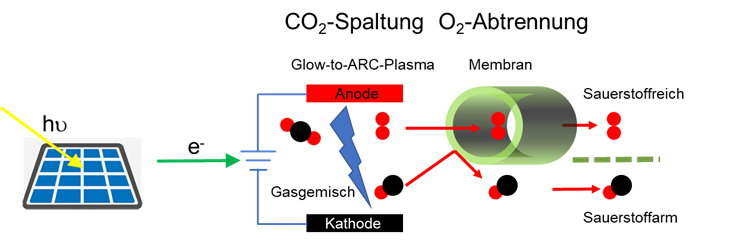
created with BioRender.com
Project information
Project title
P2M2X – Development of a novel plasma membrane reactor for carbon dioxide splitting
Project duration
March 2026 – February 2029
Project partner
- Cyclize GmbH (Coordinator)
- Institut für Photovoltaik – Elektrische Energiespeichersysteme (ipv-EES)
- Universität Stuttgart
Funding
We would like to thank the German Federal Ministry of Research, Technology and Space (BMFTR) and DISCO2 for funding the project P2M2X, promotional reference 033RC042B.
