 Fraunhofer Institute for Interfacial Engineering and Biotechnology IGB
The AVID project develops an aptamer-based filter cartridge that enriches infectious viruses from water and wastewater, enabling fast and reliable monitoring of viral contamination. For the first time, this provides a robust distinction between infectious and inactivated viruses for water analytics.

AVID-Virus
© RDVector/stock.adobe.com
AVID – Aptamer-based virus detection in water and wastewater
Challenges
Reliable monitoring of viral contamination in water and wastewater is analytically challenging: viruses typically occur at very low concentrations, are heterogeneously distributed, and even a few infectious particles can pose a significant health risk. With EU Regulation (EU) 2020/741 on water reuse and the introduction of somatic coliphages as viral indicator organisms in the German drinking water ordinance, the need for robust viral monitoring is increasing. Classical culture-based assays are the gold standard for assessing infectivity but are slow, cost-intensive and often not applicable to many clinically relevant viruses. PCR-based methods are fast and sensitive, but detect viral genomes regardless of infectivity and may therefore overestimate the actual infection risk – a standardizable method capturing both infectivity and concentration is missing.
Objectives and project plan
AVID aims to develop a simple, standardizable method for detecting potentially infectious viruses in water and wastewater. The core component is a filter cartridge in which specific aptamers are immobilized on a carrier material to capture and concentrate intact virus particles from large water volumes, while removing matrix components and free nucleic acids. Captured viruses are eluted and quantified using established virus-genome-specific PCR assays, thus creating a phenotype–genotype coupling (PGK) between virus particle and genome. The project comprises the selection and optimization of suitable aptamer structures via SELEX, the development of the PGK platform matrix up to a demonstrator for sampling at standard water taps, and validation of sensitivity and specificity against culture-based reference methods. In parallel, we prepare IP protection and standardization activities to feed the technology into future ISO/DIN standards for viral water analytics.
Impact
AVID will provide end users with an analytical method that enables faster and more reliable assessment of infection risks caused by viruses in water. Operators of waterworks, wastewater treatment and reuse systems will be able to better evaluate disinfection and hygienization processes and comply with emerging regulatory requirements on viral water monitoring. Service providers in water analytics and diagnostics will gain a scalable platform technology with first-to-market potential for the upcoming regulated market of viral water analytics. In the long term, the aptamer-based PGK platform can be transferred to other indicator viruses and pathogens and embedded in standards, thereby improving the microbiological safety of drinking water and irrigation systems.
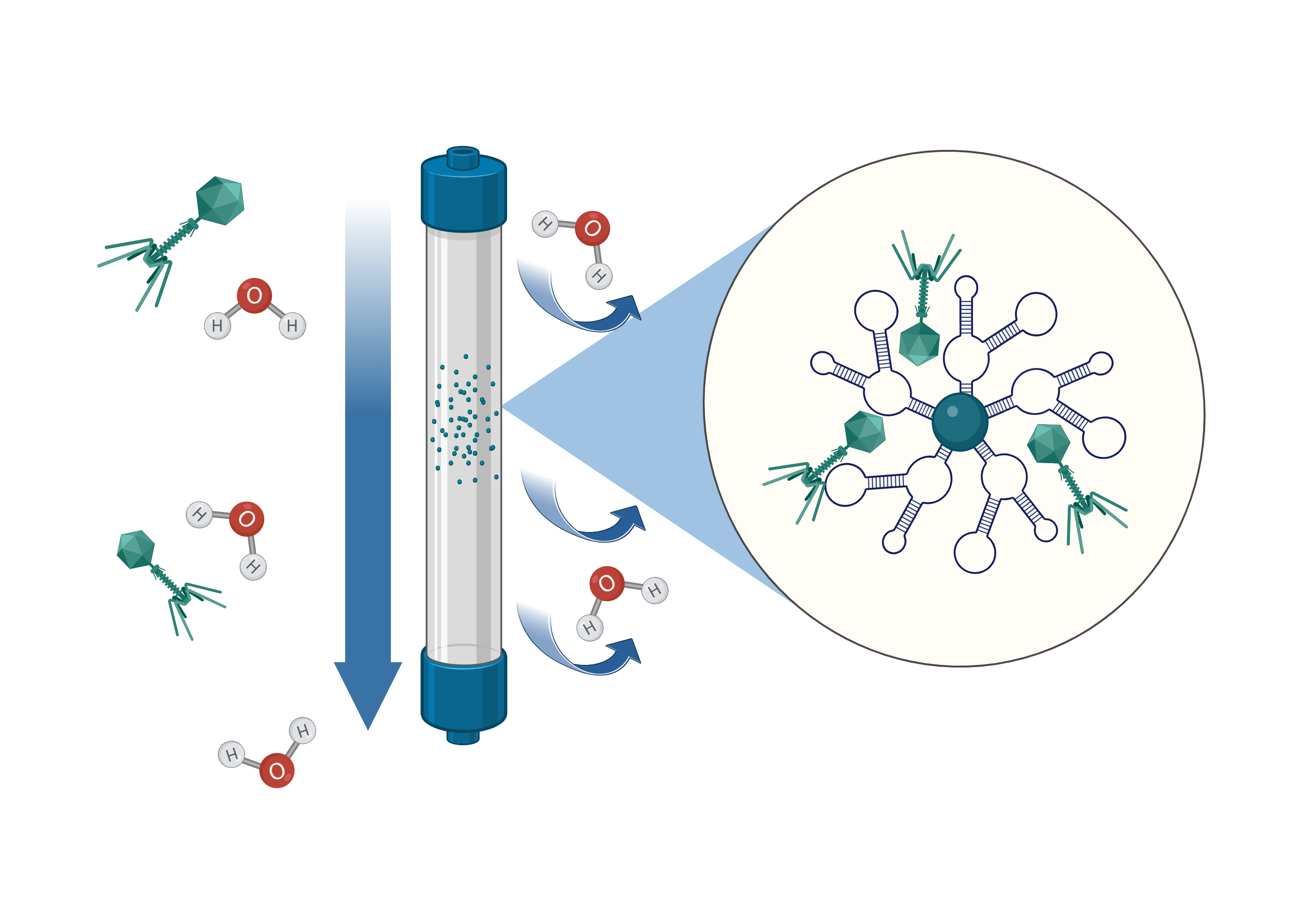
Operating principle of the AVID filter cartridge: Aptamers integrated into the cartridge selectively bind virus particles at specific surface structures. This innovative approach concentrates and purifies viral material from the water sample in a single step, while simultaneously removing destroyed (non‑infectious) viral material.
This enables rapid and accurate differentiation between infectious and inactivated viruses in water using standard virus genome-specific PCR methods.
Project information
Project titel
AVID – Aptamer-based virus detection in water and wastewater
Project duration
January 2024 – December 2026
Funding
The project “AVID” is funded by the Fraunhofer-Gesellschaft within the internal SME program.