Challenge and motivation
JEThylen is addressing the production of sustainable aviation fuels (SAF). The transport sector faces the challenge of drastically reducing its greenhouse gas emissions. In aviation in particular, liquid aviation fuels remain indispensable in the long term due to the high energy density requirements. SAFs, which can be used within existing infrastructure worldwide, are therefore regarded as key for the decarbonization of aviation. In addition to its use as a SAF precursor, ethylene, as the most important organic base chemical in the chemical industry, is of enormous economic significance. The project thus not only opens up a sustainable fuel pathway, but also offers prospects for climate-neutral chemical production.
Innovative approach
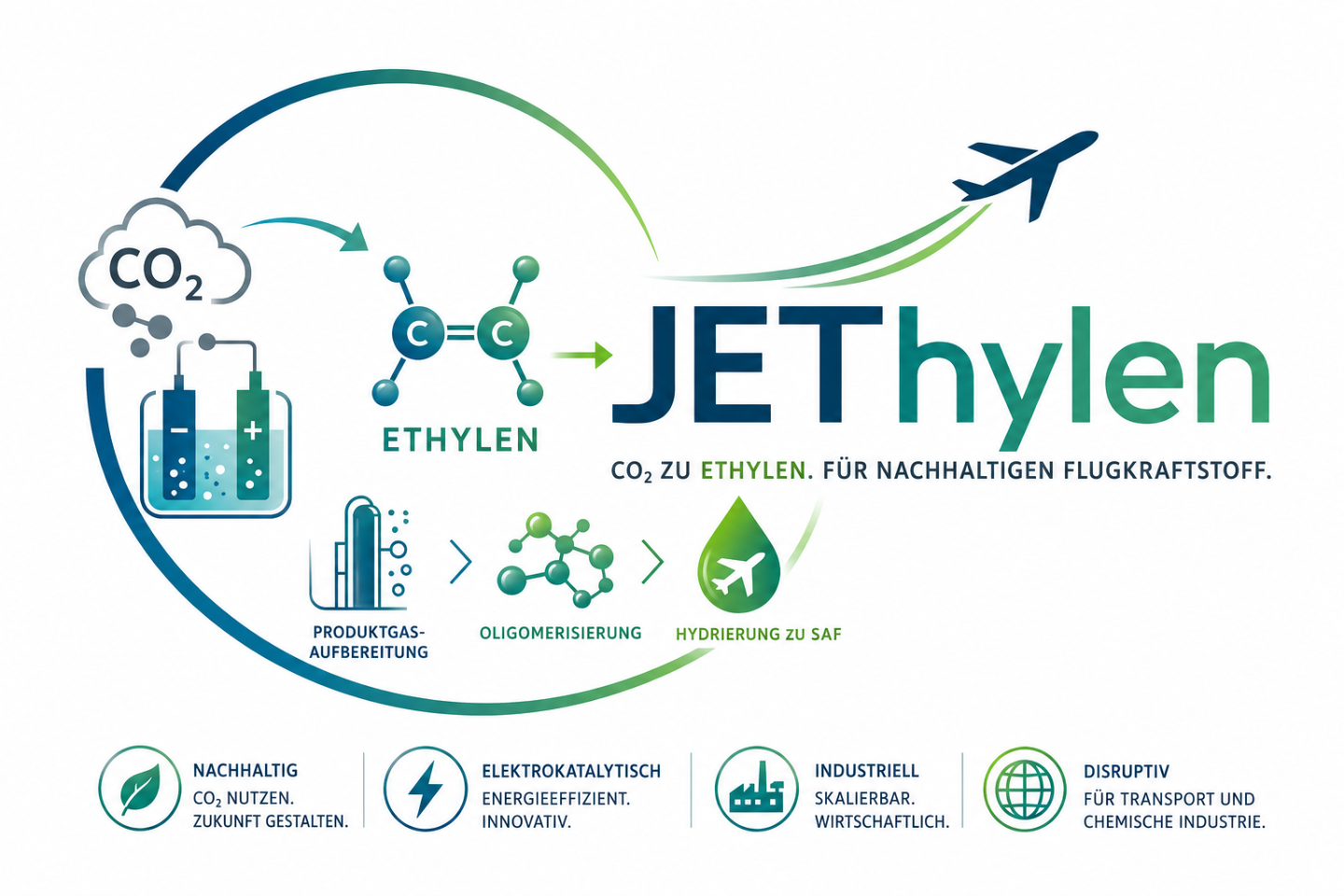
JEThylen pursues a disruptive approach to CO₂ utilization (Carbon Capture and Utilization, CCU) by directly reducing CO₂ electrochemically to ethylene. Ethylene then serves as an intermediate chemical for the production of sustainable aviation fuels. This approach promises higher energy efficiency, lower process complexity and new industrial value chains.
The process chain developed in JEThylen comprises three key steps:
- Electrocatalytic reduction of CO₂ to ethylene
- Processing and purification of the product gas
- Catalytic conversion of ethylene to SAF via oligomerization and hydrogenation
In the JEThylen project, Fraunhofer IGB is linking the electrocatalytic cell, via a gas treatment process, to the catalytic oligomerization of ethylene into fuels. The focus here is on the long-term operation of the electrolyzer and the development of the gas purification unit.
Implementation and added value
The project results lay the foundation for industrial implementation through scaling up to demonstration plants and integration into existing infrastructures and markets. JEThylen delivers significant added value through access to growing markets for sustainable aviation fuels and climate-neutral ethylene, thereby making an important contribution to climate-neutral mobility and industry of the future.
 Fraunhofer Institute for Interfacial Engineering and Biotechnology IGB